Watchman Search Guide
All screening goes through /v2/search. Send a type, a name, and any IDs, dates, or addresses you have. Watchman returns ranked hits with a score from 0 to 1.
Practical recipe: Using Watchman.
Overview
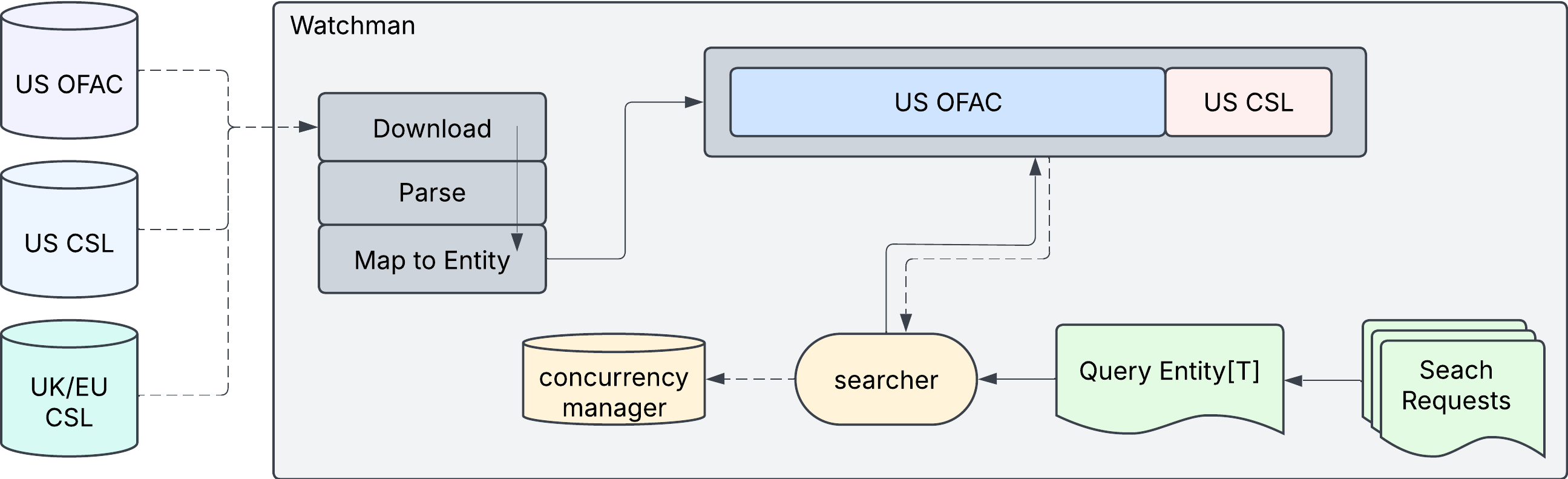
Search Endpoint
Screening is GET /v2/search. There is no JSON POST body on this path.
GET /v2/search?type=person&name=Dmitry+Khoroshev&gov_passport=RU:2018278055&minMatch=0.80&limit=1
Wait until GET /v2/listinfo shows us_ofac (or your lists) before the first search. A matching passport scores 1.0; the same name without an ID is below 0.80.
Senzing Formatting
Set the Accept header or format query parameter to receive responses in senzing format. To receive responses as JSON Lines specify the subformat as seen below.
Accept: senzing       # Array of objects [{...}, {...}]

Accept: senzing/jsonl # One object per line {...}\n{...}
The format query parameter accepts this as well, ?format=senzing or ?format=senzing/jsonl.
Matching Algorithm
Name scoring defaults to Watchman’s Jaro-Winkler setup. Pass algorithm to select a string-matching algorithm per request:
| Value | Behavior |
|---|---|
jaro-winkler (default) |
Token pairwise Jaro-Winkler scoring |
soundex |
Jaro-Winkler with a Soundex phonetic boost for token pairs that encode to the same code (e.g. “Smith” / “Smythe”) |
soft-bidist |
Soft-Bidist character-bigram edit distance (Hadwan 2021). Aliases: soft-bigram, bidist |
soft-bisim |
Soft-Bisim character-bigram similarity (Millán-Hernández 2019). Alias: bisim |
editex |
Editex phonetic-group edit distance (Zobel & Dart 1996) |
nsim |
Kondrak N-SIM n=2 (BI-SIM). Aliases: n-sim, kondrak |
nsim-3 |
Kondrak N-SIM n=3 (Trigram-2B affixing). Alias: trigram |
double-metaphone |
Jaro-Winkler with a Double Metaphone boost when codes overlap |
beider-morse |
Jaro-Winkler with a Beider-Morse boost when generic keys overlap. Alias: bmpm |
GET /v2/search?type=person&name=smythe&algorithm=soundex
GET /v2/search?type=person&name=aleksandr&algorithm=soft-bidist
Inner scorers (soft-bidist, soft-bisim, editex, nsim, nsim-3) replace only the token pair metric. Phonetic options (soundex, double-metaphone, beider-morse) keep Jaro-Winkler and boost pairs whose encodings match. BestPairs alignment, length-difference penalty, and first-letter phonetic filter still apply. Jaro-Winkler remains the default.
See Algorithm comparison for a generated score matrix (TF-IDF on/off) on paper and OFAC-style pairs.
When algorithm is omitted, process-wide flags such as USE_SOUNDEX_MATCHING still apply. An explicit algorithm value overrides those flags for that request. See Similarity Configuration.
Entity Types
type is not required. Send it anyway.
| Type | Description | Example Query |
|---|---|---|
person |
Individual persons | ?type=person&name=Dmitry+Khoroshev&gov_passport=RU:2018278055&minMatch=0.80 |
business |
Business entities | ?type=business&name=tidewater |
organization |
Non-business organizations | ?type=organization&name=hamas |
aircraft |
Aircraft registrations | ?type=aircraft&callSign=EP-GOM |
vessel |
Maritime vessels | ?type=vessel&imoNumber=9401598 |
What the code does:
- Omitted
type— searches the all-types partition for that source. Slower. Name, address, email, phone, website, domain, crypto, and SWIFT/BIC still apply. Person/business/vessel fields (birthDate,gov_*,imoNumber,altNames, …) are not read; sending them withouttypeis HTTP 400 (unused query parameter). - Correct
type— searches that source×type partition only. This is the production path. - Wrong
type(type=businessfor a person) — searches only that partition. The designated party is missing from the page. Watchman does not fall back to other types.
Person, business, and organization records can still be compared to each other during scoring when both sides are already candidates. A person query is not scored against a vessel or aircraft. An empty type partition (for example type=aircraft on a list with no aircraft) returns no matches.
See Performance, Indexing, and Record linkage.
When a passport, national ID, IMO, MMSI, aircraft serial, crypto address, or SWIFT/BIC matches on identifier and country, the score is 1.0. A matching tax number, company registration, email, phone, website, or domain raises the score; it does not force 1.0.
Advanced Entity Search Parameters
Each entity type supports specific search parameters:
Person Parameters
name: Primary namealtNames[]: Alternative namesgender: Gender (male/female/unknown)birthDate: Date of birth (YYYY-MM-DD,YYYY-MM, orYYYY)deathDate: Date of deathtitles[]: Professional titlesgov_<type>: Government IDs asCOUNTRY:IDENTIFIER(e.g.gov_passport=IR:Y53914915,gov_national=US:1234,gov_tax=RU:9709063550)
Business/Organization Parameters
name: Entity namealtNames[]: Alternative namescreated: Formation date (YYYY-MM-DD,YYYY-MM, orYYYY)dissolved: Dissolution dategov_<type>: Registration / tax IDs asCOUNTRY:IDENTIFIER(evidence, not a 1.0 identity key)
Aircraft Parameters
name: Aircraft name/identifieraltNames[]: Alternative designationsaircraftType: Type of aircraftflag: Country of registrationbuilt: Build date (YYYY-MM-DD)icaoCode: ICAO codemodel: Aircraft modelserialNumber: Serial number
Vessel Parameters
name: Vessel namealtNames[]: Alternative namesimoNumber: IMO numbervesselType: Type of vesselflag: Flag countrybuilt: Build date (YYYY-MM-DD)mmsi: MMSI identifiercallSign: Radio call signtonnage: Vessel tonnagegrossRegisteredTonnage: GRT measurementowner: Vessel owner
Common Parameters for All Entity Types
source: Restrict to one list (us_ofac,eu_csl,uk_csl,un_csl,us_csl, …)sourceID: Exact record id on that list (OFAC entity ID, etc.)address[]: Physical addressesemail[],emailAddress[],emailAddresses[]: Email addressesphone[],phoneNumber[],phoneNumbers[]: Phone numbersfax[],faxNumber[],faxNumbers[]: Fax numberswebsite[],websites[]: Associated websites (host match after dropping scheme, path, andwww.)domain[],domains[]: DNS names matched against listed websites and email hosts. Every label from the query host down to eTLD+1 (Public Suffix List) is tried, somail.suex.iomatches a listedsuex.io. Public suffixes (co.uk,ru) are ignored. Consumer mail hosts taken from emails (gmail, yahoo, mail.ru) are not indexed.cryptoAddress[]: Cryptocurrency addresses (currency:address)swift[],bic[]: ISO 9362 SWIFT/BIC codes. Aliases for the same field. Always read, including whentypeis omitted (OFAC banks arebusiness; US CSL banks areorganization). 8- and 11-character forms match on the first eight characters (XXXis the head office). A matching SWIFT/BIC scores 1.0. Prefix queries (for exampleHNRB) only select candidates; scoring needs a full BIC.
Search Response
The API returns the original query plus matched entities. Each element of entities is the list record, with match (0.0–1.0) on the same object:
{
  "query": {
    "name": "Dmitry Khoroshev",
    "entityType": "person"
  },
  "entities": [
    {
      "name": "Dmitry Yuryevich KHOROSHEV",
      "entityType": "person",
      "sourceList": "us_ofac",
      "sourceID": "48603",
      "person": {
        "name": "Dmitry Yuryevich KHOROSHEV",
        "gender": "male",
        "birthDate": "1993-04-17T00:00:00Z"
      },
      "match": 1
    }
  ]
}
Name, alias, and address
Aliases are searched with the primary name. Pass extras as altNames:
GET /v2/search?type=business&name=NATIONAL+BANK+OF+CUBA&altNames=BANCO+NACIONAL+DE+CUBA&minMatch=0.80
Addresses are free-text on address (libpostal in Docker and Linux/macOS releases, usaddress otherwise, deepparse if enabled):
GET /v2/search?type=person&name=maduro&address=Caracas,+Venezuela&minMatch=0.80
Filtering Results
Filtering is built into the entity model:
GET /v2/search?type=person&name=maduro&minMatch=0.8
Parameters:
minMatch: Minimum match score (0.0–1.0). Use 0.80 for a production-shaped queue; ~0.59 when missing a designation is costlier than extra review. See Using Watchman.limit: Maximum results (default 10, max 100)debug: Include field-level score pieces (identifiers, name, dates, override/conflict).true/yes/1attaches debug to every returned hit. A number such as0.80attaches debug only whenmatchis at least that score. Debug is computed after ranking, only for those hits.algorithm: Per-request name metric (see above). Defaults to Jaro–Winkler.
Cross-script name matching
Jaro–Winkler scores near 0 when the query is Arabic, Cyrillic, or Chinese and the list name is Latin. Enable embeddings (qwen3-embedding:0.6b via Ollama is the measured pick) and keep EMBEDDINGS_CROSS_SCRIPT_ONLY=true. The match field is still 0 to 1.
curl -s --get "http://localhost:8084/v2/search" \
  --data-urlencode "type=person" \
  --data-urlencode "name=محمد علي" \
  --data-urlencode "minMatch=0.80" \
  --data-urlencode "limit=1"
Setup, hybrid scoring, and OpenSanctions numbers: Cross-script matching.
Best Practices
- Always send
type=(andsource=when you only need one list). It is optional in the API, but omitting it is slower and GET will reject person/business fields. Unknown type: call person and business (and vessel/aircraft when those IDs exist). A wrong type can miss the hit. - Send IDs and dates from CDD.
gov_passport=…andbirthDate=change the score more than any Jaro–Winkler env flag. Name-only is down-ranked. - Set
minMatch. 0.80 is a typical screening line (most hits are real). 0.59 returns more possible matches. Measured numbers: OpenSanctions Pairs. - Turn on embeddings for names in Arabic, Cyrillic, Chinese, and similar scripts. Soundex and other phonetic flags help little there. See Cross-script matching.
- Use
debug=trueordebug=0.80on hits you investigate. That is the exam artifact for why a score landed. A numeric threshold lets screening attach pieces only to stored hits.
List Information
GET /v2/listinfo returns metadata about the currently loaded lists:
{
  "lists": { "us_ofac": 12345, "us_csl": 442, ... },
  "listHashes": { "us_ofac": "0629...9aab", ... },
  "startedAt": "2025-...",
  "endedAt": "2025-...",
  "version": "v0.69.0"
}
This is useful for monitoring data freshness and which lists are active. The Go client exposes this via ListInfo(ctx).
API Documentation
For complete API details, refer to the API Documentation.